Blog
Nov 2026
Menopause Skin Changes: Why Your Skin Feels Different and How to Support It
There can be a point during menopause when the skincare routine you have relied on for years suddenly does not seem to work in quite the same way.
Your skin may feel drier even though you are moisturising regularly. Fine lines can seem more noticeable, particularly when the skin is dehydrated. Perhaps your complexion feels thinner, more sensitive or less resilient, or you have noticed that some of the firmness and natural radiance you once took for granted has gradually changed.
For some women, these changes happen slowly. For others, they seem to become noticeable within a surprisingly short period of time.
There is a biological reason for this. The hormonal changes associated with menopause can influence collagen, hydration, elasticity, skin renewal and repair. Your skin has not suddenly become “bad” skin. Its needs are changing, and understanding those changes can help us support it more effectively.
At Dr Liesel Medical Aesthetics, our approach to menopausal skin is centred on improving skin health, strength and quality. Rather than chasing every line individually, we consider what the skin may be losing and how we can help it feel healthier, more hydrated and resilient again.
Why Does My Skin Suddenly Feel Different During Menopause?
Oestrogen plays an important role in maintaining collagen, hydration, elasticity and healthy skin renewal. As levels decline during menopause, several of these processes can change at the same time, which is why your skin may suddenly feel drier, thinner, less firm or more sensitive.
Reduced moisture retention can leave the complexion feeling tight or rough, while collagen loss and slower skin renewal may make fine lines, crepiness and uneven texture more noticeable. Even a moisturiser that has worked well for years may no longer feel sufficient.
Supporting menopausal skin therefore means looking beyond individual concerns. Restoring hydration, strengthening the skin barrier and supporting collagen and overall skin quality can all form part of helping the complexion feel healthier and more resilient again.
What Happens to Collagen During Menopause?
Collagen provides much of the structural support that helps skin feel firm and resilient.
During menopause, declining oestrogen is associated with more rapid collagen loss. As the skin’s structural support changes, you may notice that it feels thinner, less springy or less able to maintain the firmness it once had.
Fine lines can become more established, while areas such as the face, neck and décolletage may begin to appear more crepey or lax.
This is one reason our approach often focuses on treatments that support collagen production and tissue quality rather than concentrating exclusively on what can be seen at the surface.
Healthy ageing is not simply about smoothing lines. It is also about helping the skin maintain as much strength and resilience as possible.
Why Has My Skin Lost Its Glow?
Radiance is influenced by more than skincare products.
Skin cell renewal naturally slows with age and hormonal change. When renewal becomes less efficient, the surface can appear duller and texture may feel less smooth.
Dryness can compound this effect. When the skin lacks hydration and the surface becomes rougher, it does not reflect light as evenly, which can contribute to that familiar feeling that your complexion has lost some of its previous freshness.
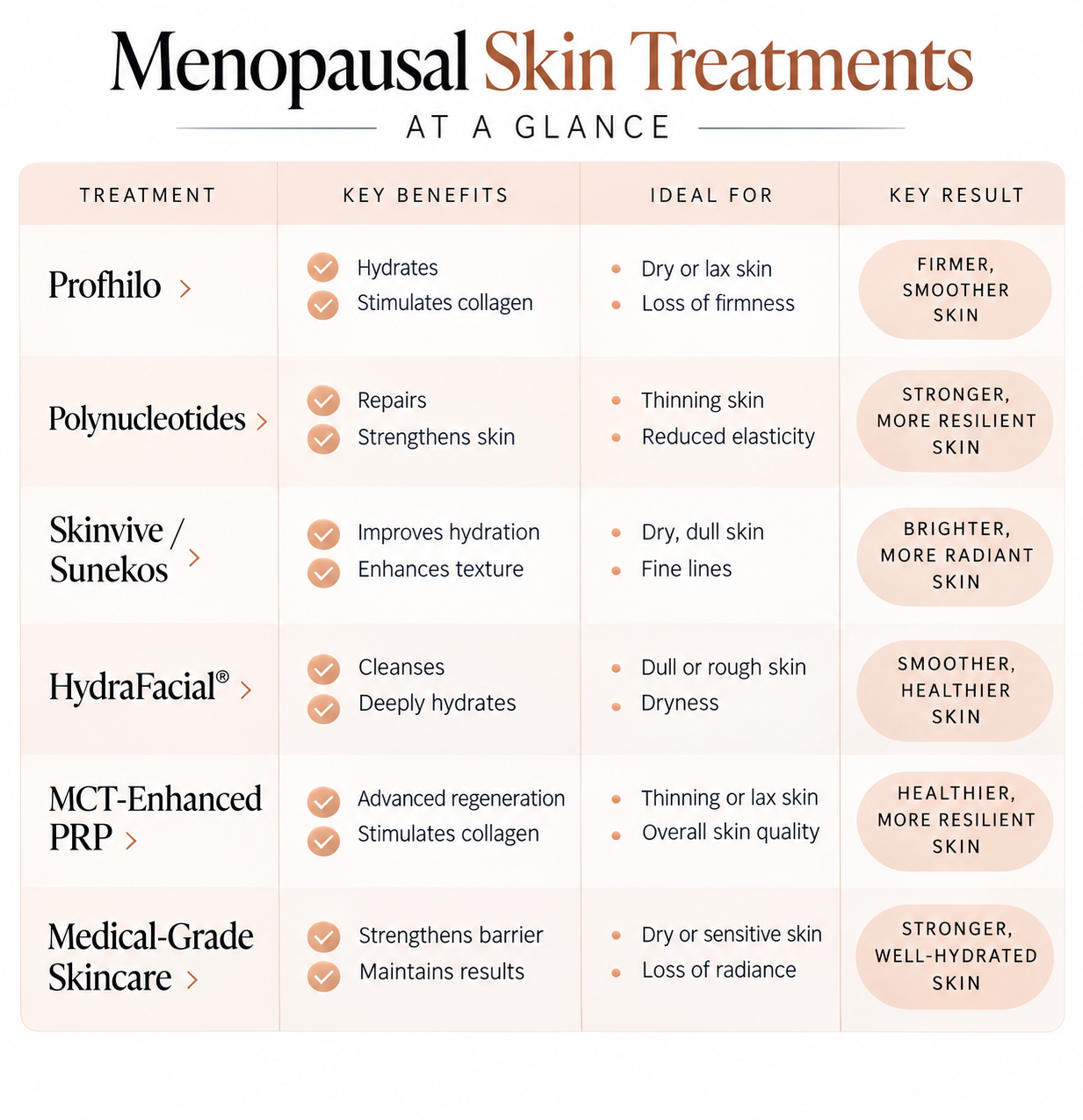
Treatments such as HydraFacial® may form part of a menopausal skin programme where dryness, dullness and surface texture are particular concerns. By cleansing, exfoliating and hydrating the skin, treatment can help support a fresher, smoother complexion.
Does Menopause Make Skin More Sensitive?
For some women, yes.
Changes in hydration and skin function can leave the complexion feeling less tolerant than it once was. Products you have used comfortably for years may suddenly feel too active, or you may notice increased dryness and sensitivity.
This is why menopause is often a good time to reassess your skincare rather than simply adding more products.
Medical-Grade Skincare can be selected according to what your skin needs now, with a focus on maintaining hydration, supporting the skin barrier and protecting skin health.
The most complicated routine is not necessarily the most effective. A considered programme that your skin tolerates consistently can be far more valuable.
Can We Support the Skin From Within?
Where menopause has affected hydration, collagen, elasticity and tissue quality, injectable and regenerative treatments may be considered alongside skincare and professional skin treatments.
Profhilo is a bio-remodelling treatment that can improve skin hydration while supporting collagen and elastin production. It may be particularly relevant where the skin feels less firm, less hydrated or increasingly crepey.
Polynucleotides take a regenerative approach, supporting tissue repair and collagen production. They may be considered when menopausal skin has become thinner or its overall quality and elasticity have declined.
Skin boosters can also play a role. Skinvive and Sunekos may be incorporated into an individual treatment plan to support hydration, texture, elasticity and overall skin quality.
The important point is that these treatments are not interchangeable. Menopausal skin does not require a standard “menopause treatment”. What is appropriate depends on what has actually changed in your skin.
Where Does MCT-Enhanced PRP Fit Into Menopausal Skin Treatment?
For women interested in regenerative approaches, MCT-Enhanced PRP may be considered to support skin quality and natural repair processes during menopause.
MCT-Enhanced PRP uses a specialised preparation technique to concentrate platelets and growth factors from your own blood. This enhanced plasma preparation is designed to support tissue regeneration, collagen production and overall skin resilience.
Rather than creating an immediate cosmetic change, MCT-Enhanced PRP works gradually to support healthier, stronger skin. It may be particularly beneficial where menopause has contributed to thinning skin, reduced firmness and declining tissue quality.
Is It Too Late to Improve My Skin After Menopause?
No. Menopause is a transition in the biology of your skin, not an expiry date for healthy skin.
While treatment cannot stop the natural ageing process or replace the hormonal environment of younger skin, there are ways to support hydration, collagen, tissue quality and skin health during and after menopause.
The aim is not to make your skin behave as though you are 25 again. It is to understand what it needs at this stage of life and care for it accordingly.
That distinction matters. Healthy, well-supported skin can still look vibrant and beautiful at every age.
Frequently Asked Questions
Why Does My Skin Seem to Be Ageing Faster During Menopause?
Declining oestrogen affects collagen production, hydration, elasticity and the skin’s natural repair processes. As several of these changes happen together, signs such as dryness, fine lines, thinning and reduced firmness may become more noticeable.
Can Menopause Cause Very Dry Skin?
Yes. Hormonal changes can reduce the skin’s ability to retain moisture, which may contribute to dryness, roughness and increased sensitivity.
Can Skincare Alone Help Menopausal Skin?
A carefully selected skincare programme can make an important contribution to hydration, barrier support and long-term skin health. Where collagen loss or changes in tissue quality are more significant, professional treatments may also be considered as part of a personalised plan.
Which Treatment Is Best for Menopausal Skin?
There is no single treatment that is best for every woman. Profhilo, Polynucleotides, Skinvive, Sunekos, HydraFacial®, PRP and medical-grade skincare address different aspects of skin health, so recommendations should be based on an assessment of your individual skin.
How Quickly Will My Skin Improve?
This depends on what is being treated and which approach is recommended. Improvements in hydration may become apparent sooner, while changes associated with collagen production and tissue remodelling develop more gradually over the following weeks and months.
Can Menopause Skin Treatments Be Combined?
Yes. Where appropriate, treatments can be combined or introduced at different stages to address hydration, collagen, tissue quality and surface skin health. Your programme should be planned around your skin rather than combining treatments simply for the sake of doing more.
Your Skin Is Changing, Not Losing Its Potential
It can be unsettling when skin you have known for decades suddenly feels drier, thinner or less predictable. Menopause brings genuine biological changes, and adapting the way you care for your skin can make this transition feel much more manageable.
At Dr Liesel Medical Aesthetics, we are interested in helping your skin function and feel its best at the stage of life you are in now. That may mean restoring hydration, supporting collagen, improving tissue quality or simply creating a skincare routine that finally feels right for your changing complexion.
If your skin has started to feel unfamiliar during menopause, book a consultation with Dr Liesel Medical Aesthetics. We can assess what has changed and create a considered, personalised plan to support healthier, stronger and more radiant skin as you move forward.